


Are your cash savings costing you money? Here’s what tax and growth could mean for your wealth
There are many reasons you might hold savings in cash. Perhaps you want to keep funds accessible or feel safer saving rather than investing. In some cases, you may still be determining a suitable strategy for growing your wealth.
Indeed, many Brits opt to save money in cash. Forbes reports that 71% of UK adults have some form of savings account, with £1.98 trillion held in cash deposits and savings. However, much of this is kept in low-interest accounts, and HM Treasury estimates that around 29 million UK savers have cash in accounts earning just 1% interest.
Cash plays an undeniably important role in financial planning. But when saving is your default approach, rather than a strategic decision, holding on to cash could cost you money in the long run. Not only could your interest earnings be eroded by rising tax bills, but you could also miss out on significant growth opportunities.
Read on to learn how to make your savings work hard for you by boosting growth and mitigating tax liabilities.
Your savings’ tax bill could be rising
Interest earned on savings held outside an ISA may be subject to Income Tax at your marginal rate if it exceeds your Personal Savings Allowance (PSA). The PSA is the amount of interest you can earn each year before being taxed, and it decreases as you move up the tax bands.
What’s more, the tax rates for savings interest will rise by two percentage points from April 2027, which will likely further inflate savers’ tax bills. You can see the current and future rates in the table below.
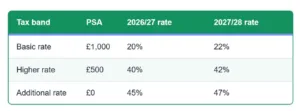
As your income rises, you could lose some or all of your PSA, while becoming subject to a higher tax rate.
Indeed, tax on savings is already increasing. According to MoneyAge, the number of savers paying over £10,000 a year in tax on their savings interest will rise by an estimated 289% between 2022/23 and 2026/27.
While there are numerous factors behind this trend, “fiscal drag” is likely the main driver. This is when the tax burden rises despite tax rates remaining the same.
For instance, the current Income Tax thresholds are set to remain frozen until 2031, having already remained unchanged since 2021. As earnings rise over time, more people are moving into the higher- and additional-rate tax bands. This leads to more people paying a higher rate of tax on their income, including the interest earned on their savings.
So, to help grow your savings tax-efficiently, you might want to consider maxing out your Cash ISAs. In 2026/27, you can normally pay in up to £20,000 a year across all adult ISAs without being taxed.
However, from April 2027, the Cash ISA allowance will effectively reduce to £12,000 for under-65s, with £8,000 of the total allowance reserved for investment ISAs. As such, your tax-efficient opportunities to grow your cash with interest may be reducing.
Your savings could lose purchasing power if the interest rate doesn’t keep pace with inflation
You might be hoping to grow your savings through interest. However, if your interest earnings don’t keep pace with inflation, your money could actually lose value over time.
The Money Pages reports that the majority of UK savings are held in easy access accounts, totalling £911 billion. As of September 2026, these accounts paid interest at an average rate of 1.6%.
With inflation rising to 3.1% in the 12 months to August 2026, as the Bank of England reports, many savers will be seeing a significant shortfall between interest earnings and price increases.
What’s more, The Money Pages suggests that £306 billion of savings is earning no interest at all. These savers are losing out on a potential £12 billion in interest a year, compared with what they would earn at 4% interest.
By regularly shopping around for competitive interest rates, you may be able to boost your money’s growth and limit inflation’s impact on your cash’s purchasing power.
But choosing a suitable savings account isn’t all about finding the highest interest rate. You also need to consider any access limitations. For example, while fixed-term accounts may offer higher interest rates (3.7% average in September 2026), you may be unable to access your cash during the defined period or incur charges for early withdrawals.
A financial planner can support you in selecting suitable savings accounts that balance growth against ensuring you have the right access to the cash you need.
Your money might go further through investing
Even the best savings accounts can struggle to keep pace with inflation over time. As such, choosing to save your wealth, rather than invest it, may cost you money in the long run through lost growth opportunities.
Cash may play an important role in your financial plan, such as keeping emergency funds on hand and achieving short-term goals. But once those needs are met, you might consider investing some funds to help build more wealth for your future.
Over the long term, the investment markets have historically delivered higher growth than interest on cash savings. According to AJ Bell, over the past 10 years, the FTSE All-Share Index achieved seven times more growth than cash, with the index growing by 139% compared to 20% interest earnings on original deposits.
While past performance is not a guarantee of future results, you may be able to grow your wealth further by investing some of the funds currently held in savings.
MoneyAge suggests there is currently £1.2 trillion in savings accounts with a weighted average interest rate of 1.2%. Over the next 10 years:
- Continuing to grow at this rate would see the savings reach just £1.4 trillion
- Investing with an average annual return of 6% could grow the funds to over £2 trillion
- Matching the MSCI World Index average returns from the past decade (12.4%) would bring the figure to over £3.4 trillion.
Of course, your capital is at risk when invested. Growth is not guaranteed, and you may end up with less than you originally invested.
By carefully curating a diversified investment portfolio that aligns with your personal risk appetite and committing to long-term investments, you can help improve your chances of a positive return on your investments.
A financial planner can support you in defining a resilient investment strategy that balances returns against risks to help you grow your wealth through investing.
Get in touch
Growing your wealth isn’t just a matter of chasing the highest returns. It’s about balance: balancing growth against access, and risk against reward, while keeping an eye on your tax bills.
At J Edward Sellars, our financial planners can help you define a strategy that strikes the right balance for your needs, goals, and risk appetite.
Email enquiries@jesellars.co.uk or call 01934 875 919 to find out more about how we can help you.
Please note
This article is for general information only and does not constitute advice. The information is aimed at individuals only.
All information is correct at the time of writing and is subject to change in the future.
Please do not act based on anything you might read in this article. All contents are based on our understanding of HMRC legislation, which is subject to change.
The Financial Conduct Authority does not regulate tax planning.
The value of your investments (and any income from them) can go down as well as up and you may not get back the full amount you invested. Past performance is not a reliable indicator of future performance.
Investments should be considered over the longer term and should fit in with your overall attitude to risk and financial circumstances.
How can we help?
Have questions about your finances, your future, or unexpected funds? Get in touch for a free, friendly chat.