



Think you’re ready to retire? Use this checklist to prepare
Whether retirement is a few months or a few years away, you may be thinking about preparing for the next chapter.
This stage of life is very exciting, but taking the leap into retirement can also be daunting. There’s a lot to consider, both financially and emotionally.
Read our pre-retirement checklist below to enter the next chapter with greater confidence.
1. Track down lost and forgotten pension pots
Over the course of your career, you may have contributed to multiple pension pots – some of which you may have lost the details of or forgotten about completely.
If so, you’re not alone. The Pensions Policy Institute estimates there are 3 million lost pension pots in the UK, worth £6,220 each on average.
Of course, knowing how much you have saved, and where the savings are, is key to retirement planning. Without this visibility, you could overspend (or underspend) in retirement.
You can track down your lost pensions using the government’s Pension Tracing Service to access providers’ contact details. Alternatively, you may be able to find your scheme details by searching through old paperwork or contacting your previous employers.
It’s worth noting that the Pensions Dashboards Programme (PDP) is expected to be available from 2027/28, allowing you to view all your pensions in one place. While this may make tracing old pensions easier, you may not wish to wait for the scheme to be available if you’re starting to plan for retirement.
2. Measure your savings against your goals
Before taking the leap into retirement, it’s important to check whether you have enough saved to enjoy your ideal lifestyle and achieve your goals.
Naturally, you will first need to decide what you want retirement to look like. If you’re yet to iron out the details, you might consider using Pensions UK’s Retirement Living Standards as a baseline for calculating how much you may spend each year.
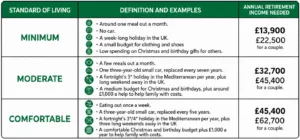
Source: Pensions UK
Be aware that these estimates don’t account for:
- Inflation throughout retirement
- Your personal preferences
- Once-in-a-lifetime expenditure, such as bucket-list holidays
- Housing costs, including rent and mortgage repayments
- The different costs associated with later life and early retirement.
As such, you’ll likely need to make adjustments to ensure your savings targets are suitable for your needs.
If you find your savings fall short of your goals, you might consider delaying or phasing your retirement, finding alternative income sources (such as downsizing your home), or revising your retirement goals.
A financial planner could calculate how much you may need to sustain your desired lifestyle in retirement.
Read more: The cost of retirement is rising: Here’s how to prepare your finances
3. Plan how you will convert your savings into a sustainable income
Having enough saved for retirement is one thing, but you also need a clear plan for drawing an income from those funds.
Without a plan, you could fall into three retirement traps:
- Overspending in early retirement and risk running out of money in later life.
- Being overly cautious with spending, meaning you miss out on opportunities like memorable family holidays.
- Overpaying tax to HMRC and depleting your wealth too quickly.
What’s more, your spending habits are unlikely to remain consistent throughout retirement. Often, retirees will spend more on travel, socialising, and enjoying hobbies in early retirement, with expenses reducing as their health and mobility decline later on. Later in life, you may face costly healthcare fees, depending on your needs.
To draw sustainably from your pensions (and other income sources), you want to strike the right balance between enjoying retirement and ensuring you have enough to meet your changing needs for the rest of your life.
Using cashflow modelling, a financial planner can help you map out and visualise your retirement income and expenses. By stress-testing different variables, you could plan a sustainable income that allows you to spend with confidence and enjoy your retirement without taking unnecessary financial risks.
4. Consider how you will spend your time in early retirement
Retirement is a significant lifestyle change. Routines and habits forged over a decades-long career come to an end, leaving you with space to create a whole new lifestyle.
You might be wondering how you’ll fill your days, socialise, or achieve a sense of purpose and fulfilment. Such uncertainty can dull some of your retirement excitement, potentially making you feel anxious or lost as you start the next chapter.
Before taking the leap, it may help to have a rough plan for how you’ll spend the first few weeks or months of retirement. Of course, there’s no one-size-fits-all plan that suits everyone, so what works for you will be very personal. Some might opt to create a structured daily routine, while others might prefer to pursue long-term goals and activities and take each day as it comes.
Whatever that plan looks like for you, putting some thought into early retirement may make it feel less overwhelming. It can also help you feel more excited for retirement, with specific activities to look forward to.
Read more: 4 clear signs you’re ready to retire (and what to do next)
Get in touch
If you’re thinking about retirement, get in touch with the J Edward Sellars team to discuss how we can support you in retiring on your own terms.
Email enquiries@jesellars.co.uk or call 01934 875 919 to find out more about how we can help you.
Please note
This article is for general information only and does not constitute advice. The information is aimed at individuals only.
All information is correct at the time of writing and is subject to change in the future.
Please do not act based on anything you might read in this article. All contents are based on our understanding of HMRC legislation, which is subject to change.
The Financial Conduct Authority does not regulate cashflow planning or tax planning.
A pension is a long-term investment not normally accessible until 55 (57 from April 2028). The fund value may fluctuate and can go down, which would have an impact on the level of pension benefits available. Past performance is not a reliable indicator of future performance.
The tax implications of pension withdrawals will be based on your individual circumstances. Thresholds, percentage rates, and tax legislation may change in subsequent Finance Acts.
How can we help?
Have questions about your finances, your future, or unexpected funds? Get in touch for a free, friendly chat.